12 Quiz: Column-level transformations
13 Feature engineering
13.1 Question 1
Consider this data with outliers. 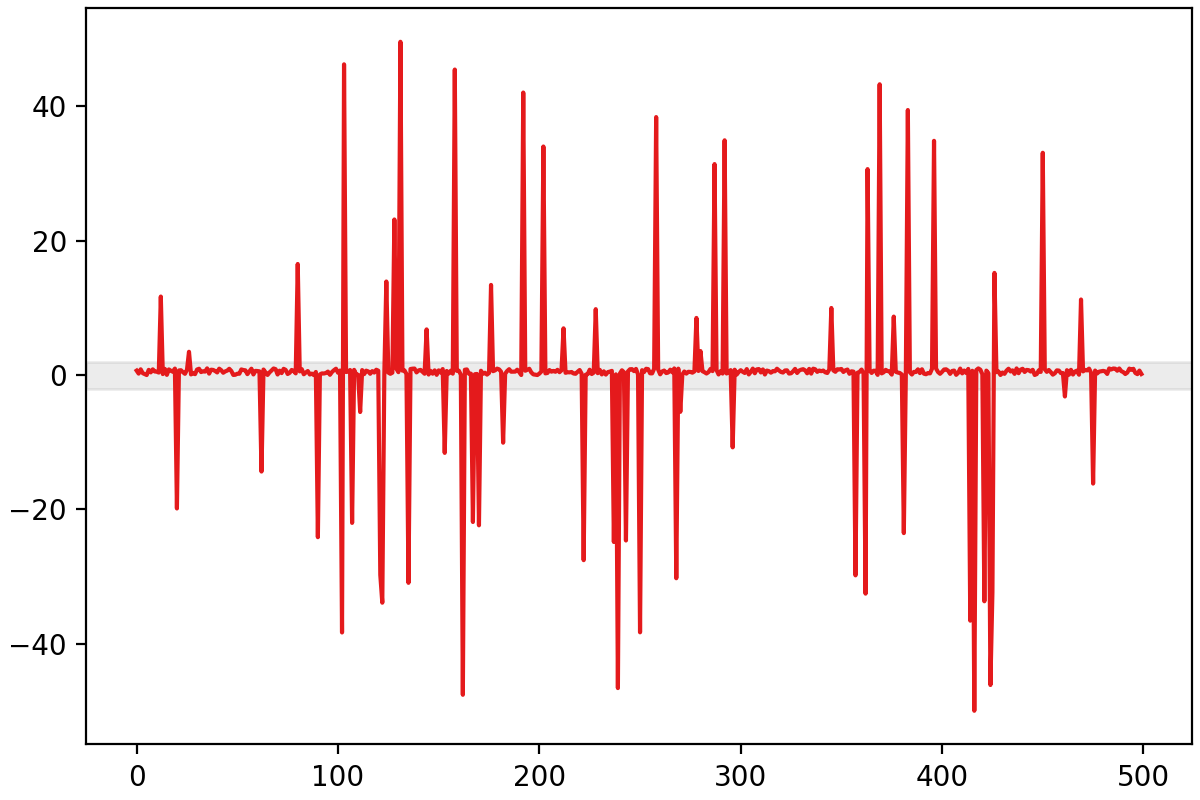
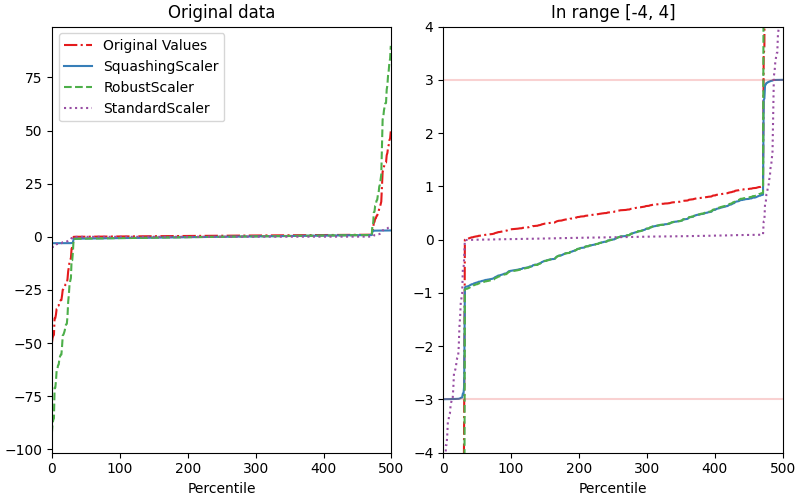
In this plot, which line shows numerical features scaled by the SquashingScaler? 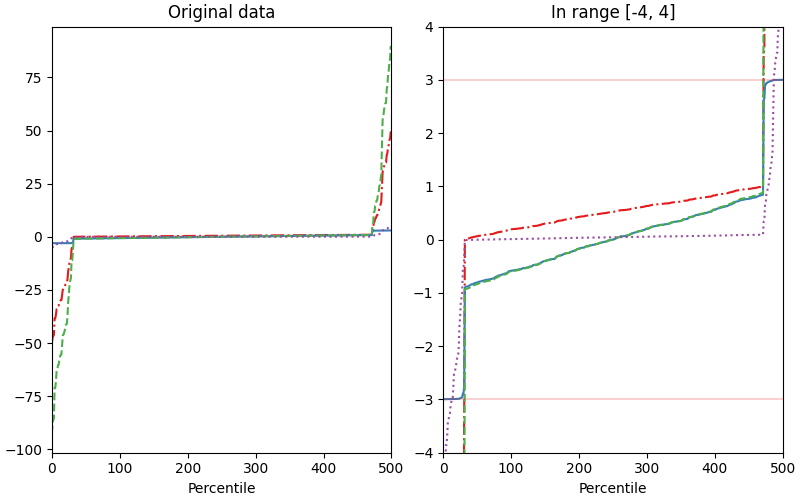
Answer A)
The solid blue line
13.2 Question 2
Answer: A)
All other parameters are available to the DatetimeEncoder.
13.3 Question 3
Answer: A)
The StringEncoder is always one of the fastest encoders to fit, and produces high quality encodings. The MinHashEncoder is faster, but it produces worse encodings. The TextEncoder can produce the best encodings for certain types of categorical data (mainly text), but is very slow to run.
13.4 Question 4
Answer: B)
The TextEncoder works best when it is applied to free-flowing text, or columns whose content may find additional context in the training set of the language model used by the encoder. User reviews fall in this category.
The OneHotEncoder would likely generate a very large number of uninformative features, and the features prepared by the OrdinalEncoder are unlikely to be informative.
The MinHashEncoder would generate a fixed number of encoded features, but the quality of the embeddings is lower than that of the TextEncoder. In a situation where computational resources are limited, it may be beneficial, but even in that case the StringEncoder may produce better results.